
🤖 What is an agent?
A snapshot of the current agent landscape.

One question we get asked more than any other right now: “What actually is an AI agent?”
It’s a fair question, because the word now means everything, and nothing. Your chatbot is an “agent.” Your CRM just launched an “agent.” The system that runs your business while you sleep is an “agent.” When a word is used as a catch-all for everything, it’s not helpful when trying to make real decisions.
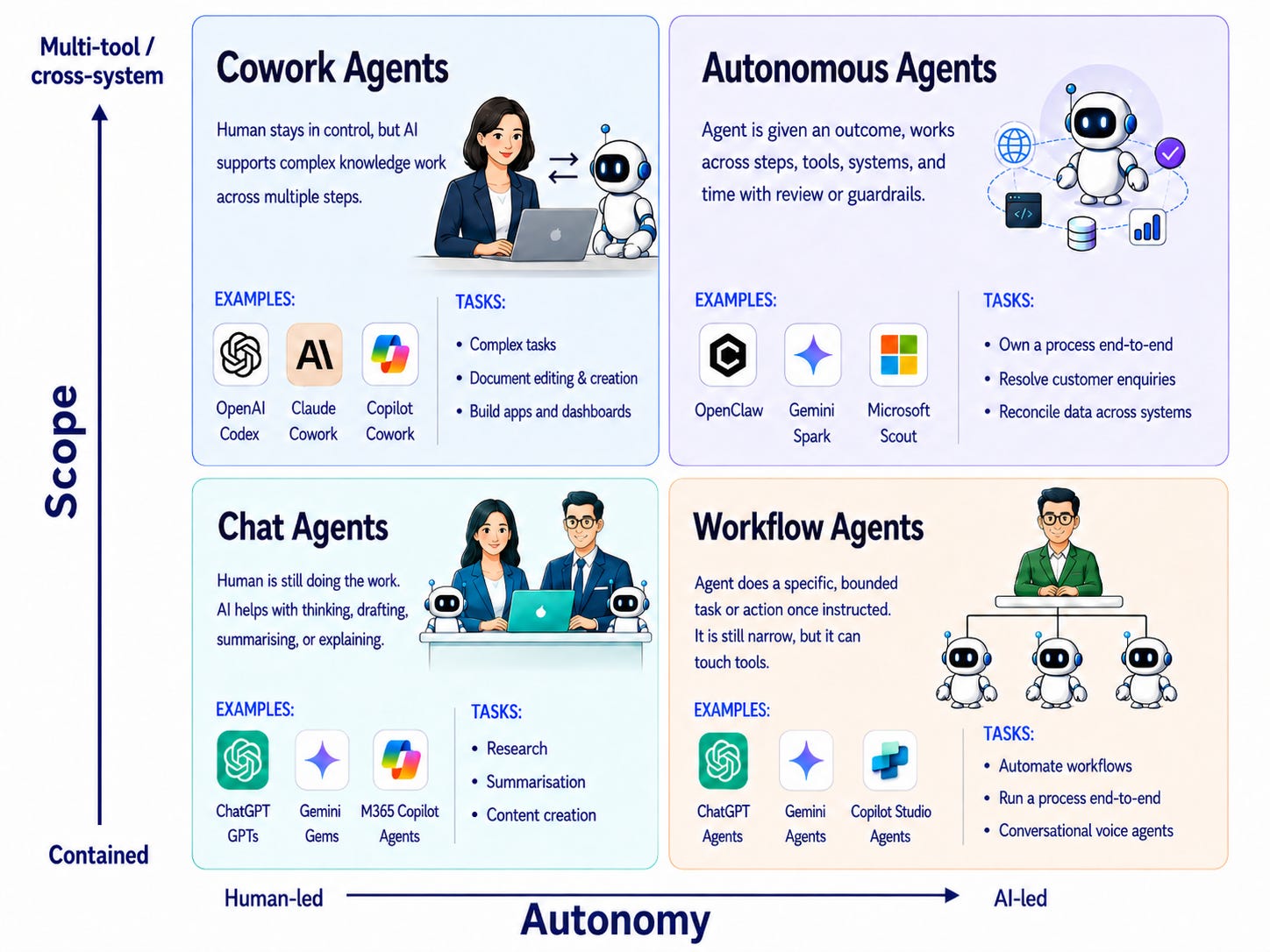
So we built this grid, a current-state snapshot, plotting the various agent types from the major AI platforms shaping the agent market: OpenAI, Anthropic, Google and Microsoft.
We plotted these agents against two key ‘agentic’ (the ability for an AI to operate autonomously) capabilities:
Scope - does the agent conduct focussed tasks or is it able to work across many tools and systems?
Autonomy - who is leading the work, you / the human or the AI?
These give us 4 helpful quadrants to reflect the current state of agents.
1. Chat Agents
This is the most familiar quadrant, and where most business AI use lives today. You do the work, AI helps you think, draft, summarise. OpenAI GPTs, Gemini Gems and Microsoft Agents are all able to cut tasks that would have taken hours, into minutes.
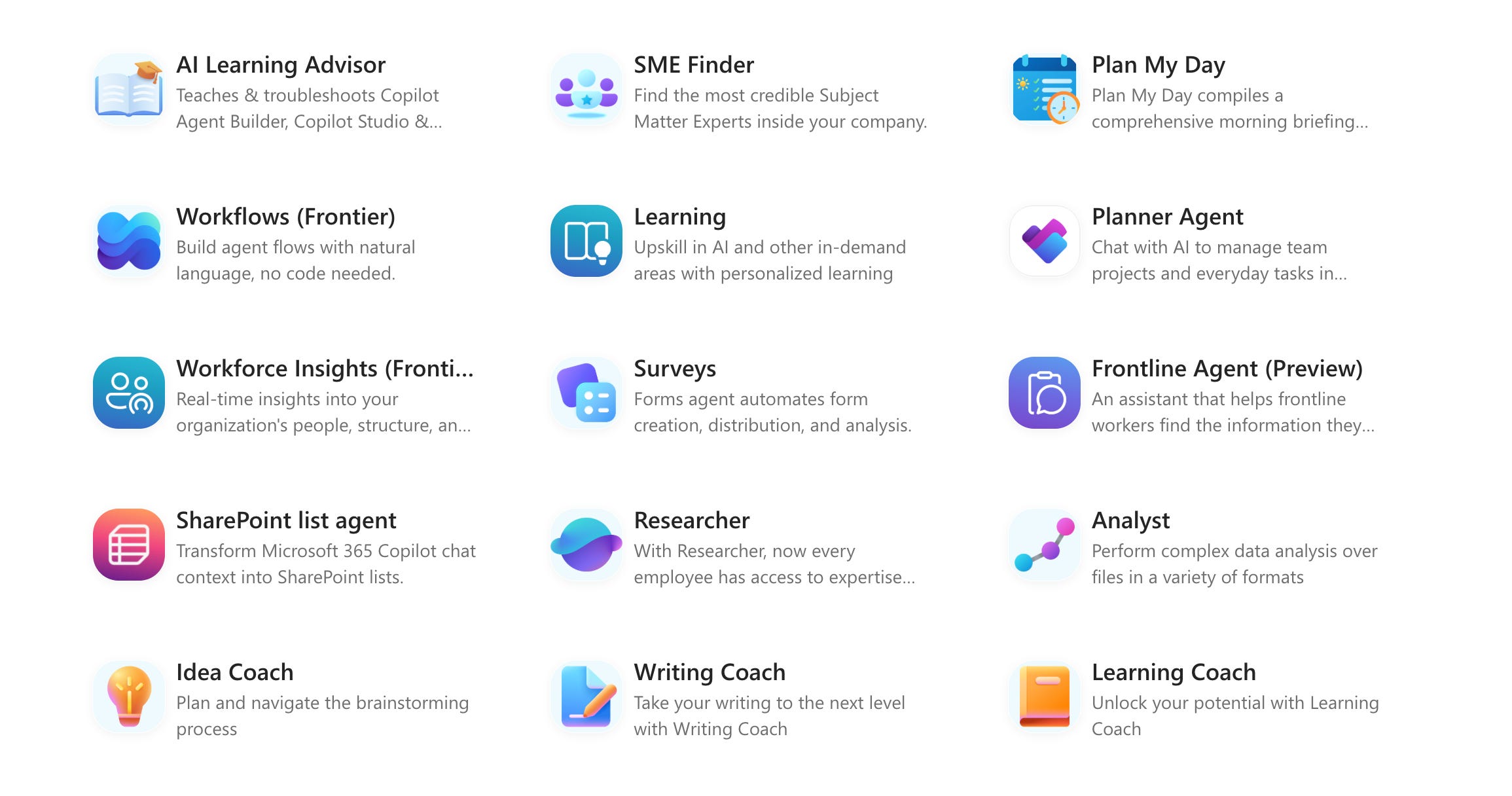
There are many use cases for Chat Agents: conducting Deep Research, turning complex data into actionable insights, copywriting and generating on-brand content, searching for answers in your enterprise data and more.
Chat Agents are being rapidly embedded into working practices today. Training and enablement remain the biggest barriers to wide scale adoption.
2. Workflow Agents
For some, Chat Agents are yesterday’s news, and Workflow Agents (and Cowork Agents) quadrants are where the real action is right now. This is where many are actively trying to work out - identifying and handing over genuine processes to the AI (Workflow).
Workflow Agents are AIs which you instruct once and they run a specific, bounded task, interfacing with your tools to get it done. ChatGPT Agent (and Agents SDK), Gemini Agent (Enterprise) and Copilot Studio all allow you to build and deploy Workflow Agents.
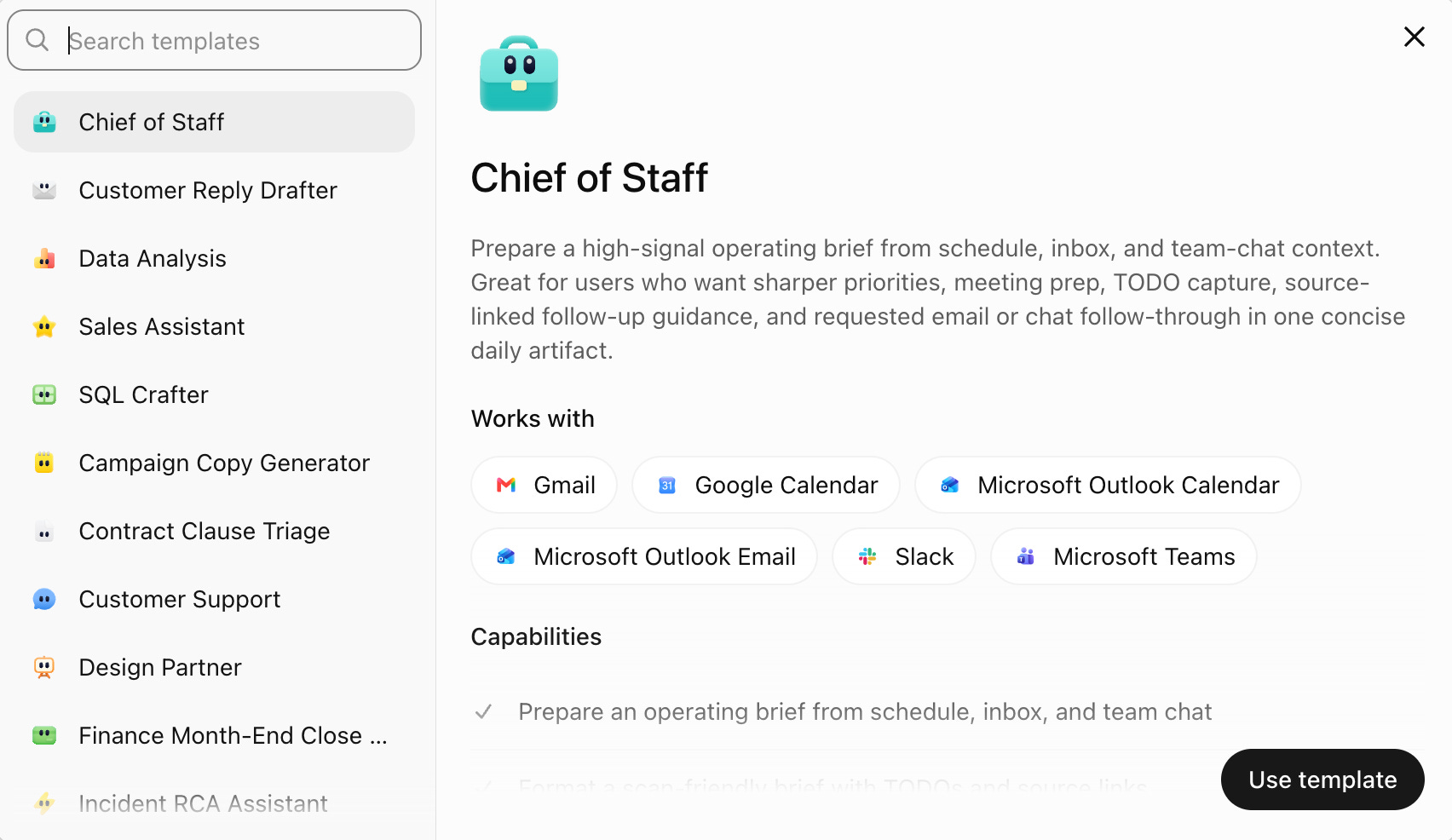
Workflow Agents are typically narrow in scope, but actually do real work. Use cases include responding to customer service requests, pushing and pulling data from your CRM, HR and IT helpdesks to answer routine questions, and voice agents that handle the calls. These are are just some use cases where Workflow Agents are being deployed in businesses today.
3. Cowork Agents
Cowork Agents work alongside you on the hard stuff (Cowork). Cowork Agents handle complex, multi-step work with the human setting direction, reviewing progress and intervening where needed. Claude Cowork, OpenAI Codex and M365 Copilot Cowork can all help you achieve great volumes of work in minutes.
Highlighting the power of Cowork Agents, OpenAI recently released Codex plugins for a range of roles: data analytics, creative production, sales, product design, public equity investing and investment banking.
In the case of coding, you stop being the developer and become the engineering lead - the agent writes the code, you manage the build. But coding is just one of many jobs that can be achieved with a Cowork Agent.
Workers are using Cowork Agents to achieve a range of diverse tasks: reorganising messy file systems, pulling data out of screenshots into spreadsheets, navigating analytics dashboards and turning raw metrics into plain-English insights, repurposing long videos into platform-ready clips, and running recurring grunt work like weekly reports and monthly summaries automatically.
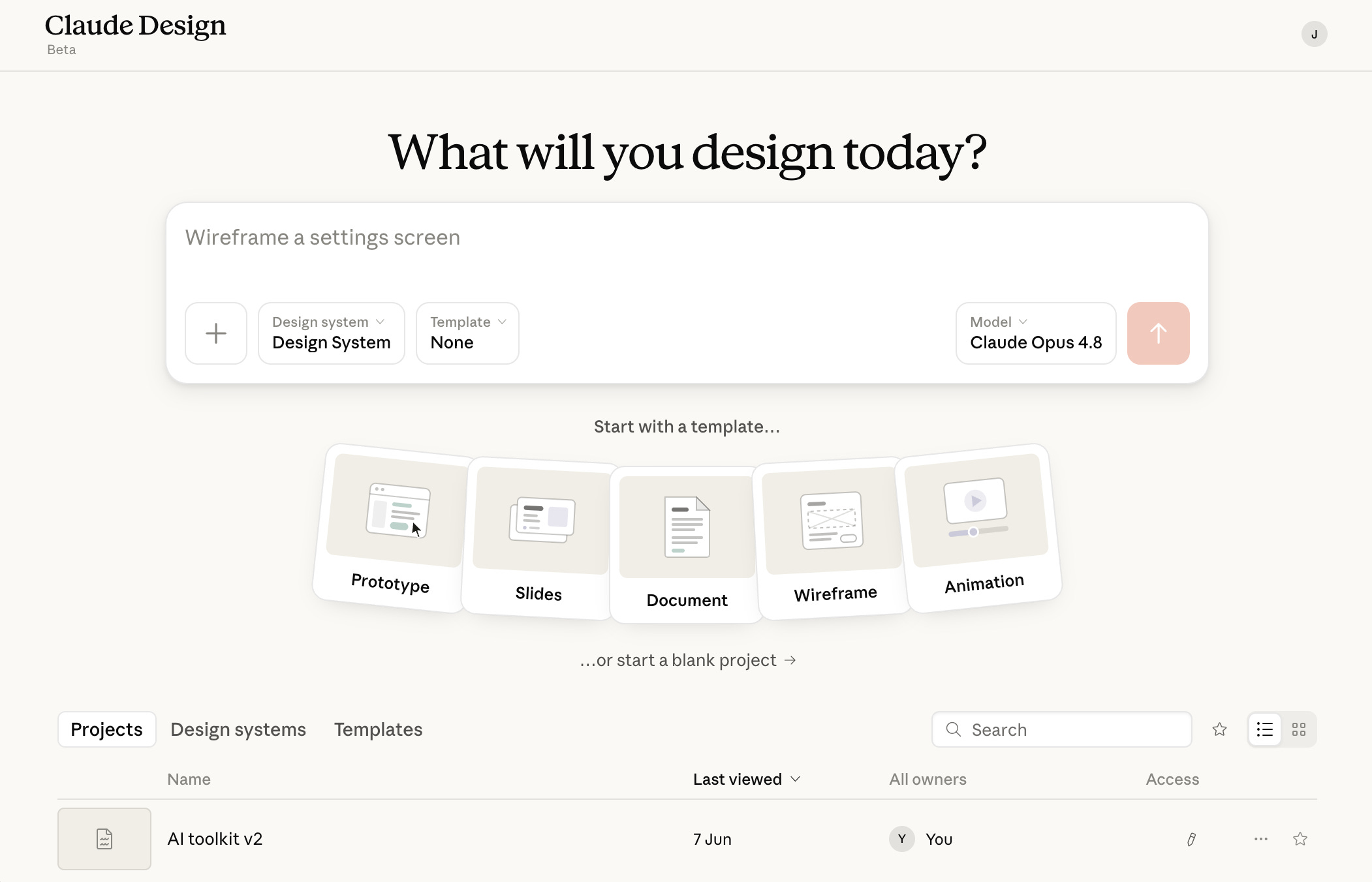
Claude Design is another example of a Cowork Agent, which can help you rapidly create on-brand prototypes, slides, documents and more.
Cowork Agents are where a lot of deployable value sits today. Most businesses should be piloting here now, but this requires a significant amount of effort - both to identify the right use cases, and learning the various methods of building these agents (e.g. how to use Skills, Connectors, Plugins and .md files). This goes beyond training and requires time and patience to achieve the right balance of human + AI working rhythm.
4. Autonomous Agents
Autonomous Agents achieve outcomes, not tasks - they are often referred to as personal AI assistants. They work across tools and time to achieve defined outcomes autonomously, with guardrails not constant supervision. This is a rapidly emerging space, with high upside, and high risks too.
The tech exists. OpenClaw proved the always-on personal agent was not just possible, but capable of attracting huge open-source momentum. Gemini Spark (announced at Google I/O) manages tasks across Gmail and Docs 24/7. Microsoft Scout (launched in June and is powered by OpenClaw) can schedule meetings and draft documents without asking permission for every step.
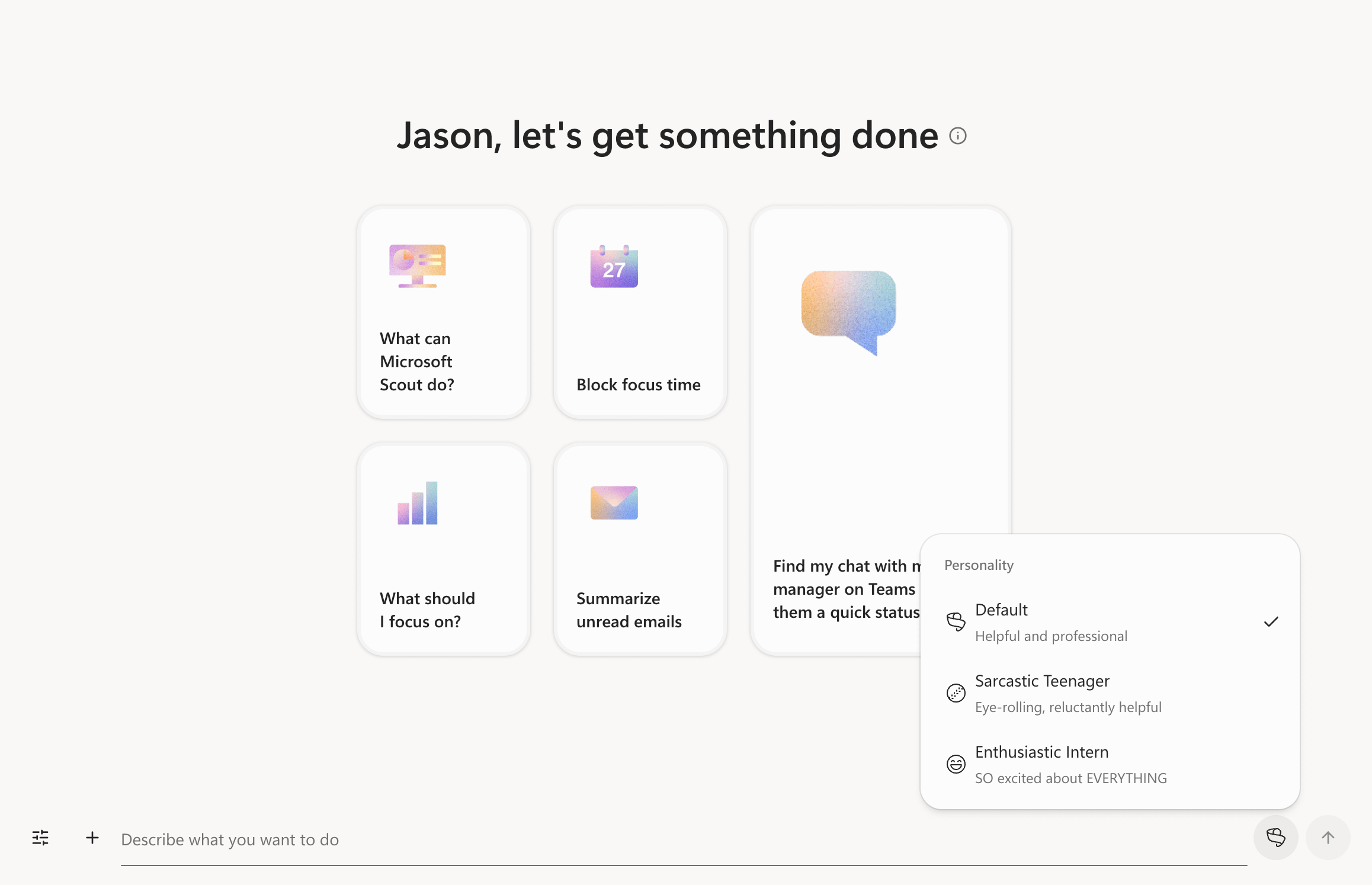
Whilst the tech exists, the use cases are still emerging and the hard part is trust and governance - key reasons why these agents have had slow take up in regulated enterprises (there is no shortage of horror stories). Microsoft are clearly trying to deal with this, with Scout’s pitch being around the trust and security layer: its own managed identity, every action policy-checked before it runs, and a full audit trail.
What this means for your business
The direction is clear - work is moving up and to the right. More scope and autonomy are being given to our AI work agents. And as it does, the conversation shifts from tools to people and roles. IDC predicts that by 2027, half of all AI-enabled enterprise apps will need entirely new oversight roles for governance and accountability. These jobs are not on most org charts today.
The optimistic view, and the one we believe: the winners won’t be the ones with the smartest agents. They’ll be the ones who worked out early which roles to augment, which tasks to hand over, and how to keep a human meaningfully in the loop. Big changes are coming to how teams are organised.
If you want help working out where your business sits on this map, that’s exactly the work we love. Reach out.
A handful of Gen AI news
Here are five interesting developments from the past couple of weeks:
ChatGPT Ads are live in Australia, read this post from Tim O’Neill to learn more.
Midjourney just made one of the biggest pivots seen of an image model provider launching Midjourney Medical.
Google is rolling out Universal Commerce Protocol in Australia “Australia is the first country in the Asia Pacific region to get access to the technology” (report from Inside Retail).
Whilst Fable 5 was just out for only couple of days, we had a chance to play and were very impressed by with this one shot "movie slate optimiser" it built (from a 10 page PRD file).
ByteDance announced Seedance 2.5 which can generate 30-second, 4K videos with a single prompt.
About Time Under Tension
We work with agencies, companies and brands to elevate Customer & Employee experiences with generative AI. Our advisory team helps you understand what’s possible and how it relates to your business. We provide training for you and your team to get the most out of generative AI tools. Our design & technology team build bespoke AI solutions to meet your needs.
Contact us: www.timeundertension.ai/contact
Thanks for reading.